Why I Built Contency: From Frustration to Platform
Good tools didn't exist — so I built them myself.
By Martin · July 10, 2026

Three projects, three content streams, the same frustration everywhere. A travel blog, the Contency site itself, and Servible — and with each of those projects I kept running into the same problem over and over again. I write for all those different projects, and as soon as a piece was finished the real work began: cutting, pasting, switching environments — all over again for every channel. On top of that, I'm more of an ad-hoc person, and often the rhythm of the week and the day determined whether anything actually went online.
I tried the well-known tools, including CMSs, AI writing tools, even auto-blogging tools — the latter quickly turned out to be a dead end: lots of text, little that sticks anywhere. Lots of content, little substance. Usually the media library is also a collection of files without intelligence, with the result that you can't find a particular photo and just upload it again. No integration with AI, no connection to a stock image library. If AI can recognise what's in a photo, it should also be possible to find images by content.
With the arrival of AI, things did become a lot easier when it came to writing and translating. But soon I hit a wall there too. Having to explain every time what you want, what structure you use, and who you're writing for. It became cut and paste. Many of the available tools produce text, but that text lacks experience.

The big names in content management are built for editorial teams with workflows, rights structures, and publication management for web pages. I wasn't looking for a CMS. I manage my own frontend myself — I don't want a tool that takes that over from me. The setup is always a lot more complicated than you'd like. Building structures when you just want to write. On top of that, the editor experience is usually well below par.
I wanted to be able to distribute content easily across the various channels. If you want to get the most out of your content, you need to reuse content across the different channels so that the same piece works in multiple places. Then optimise the content based on statistics. Tools like Yoast help with technical SEO, but they don't solve the fundamental problem: the content itself needs to be better.
With my background in software, the idea then arose: why don't I build a platform myself that puts writing good content first? One that offers a good editor? Where the AI tools know what it's about so you don't have to explain every time what you want and who your audience is? Where finding the right images is easy? And where publishing and reusing content according to a schedule can take place?
What would a good platform actually do?
My ideal tool would help me set up campaigns, write good content, and also distribute that content so the message performs optimally — without constantly switching environments. Suppose you want more visitors to your site, or you want to launch a new product. Then you need a campaign to spread that message.
The answer I was looking for wasn't complicated to describe, but turned out to be impossible to find as an off-the-shelf product. I wanted one platform that brought those things together: an editor that's pleasant to write in, AI that enhances the work instead of diluting it, and smart distribution that takes the piece to the right channels, including social media and a content calendar that provides structure. Plus a media library that classifies, retrieves, and, where needed, creates images according to your brand style.
That's what Contency became. Not as an abstract vision, but as the tool I use myself every week — for my travel blog, for this piece, and for Servible. The platform is no longer an idea; it's reality and proof that the approach works.
How does it work in practice?
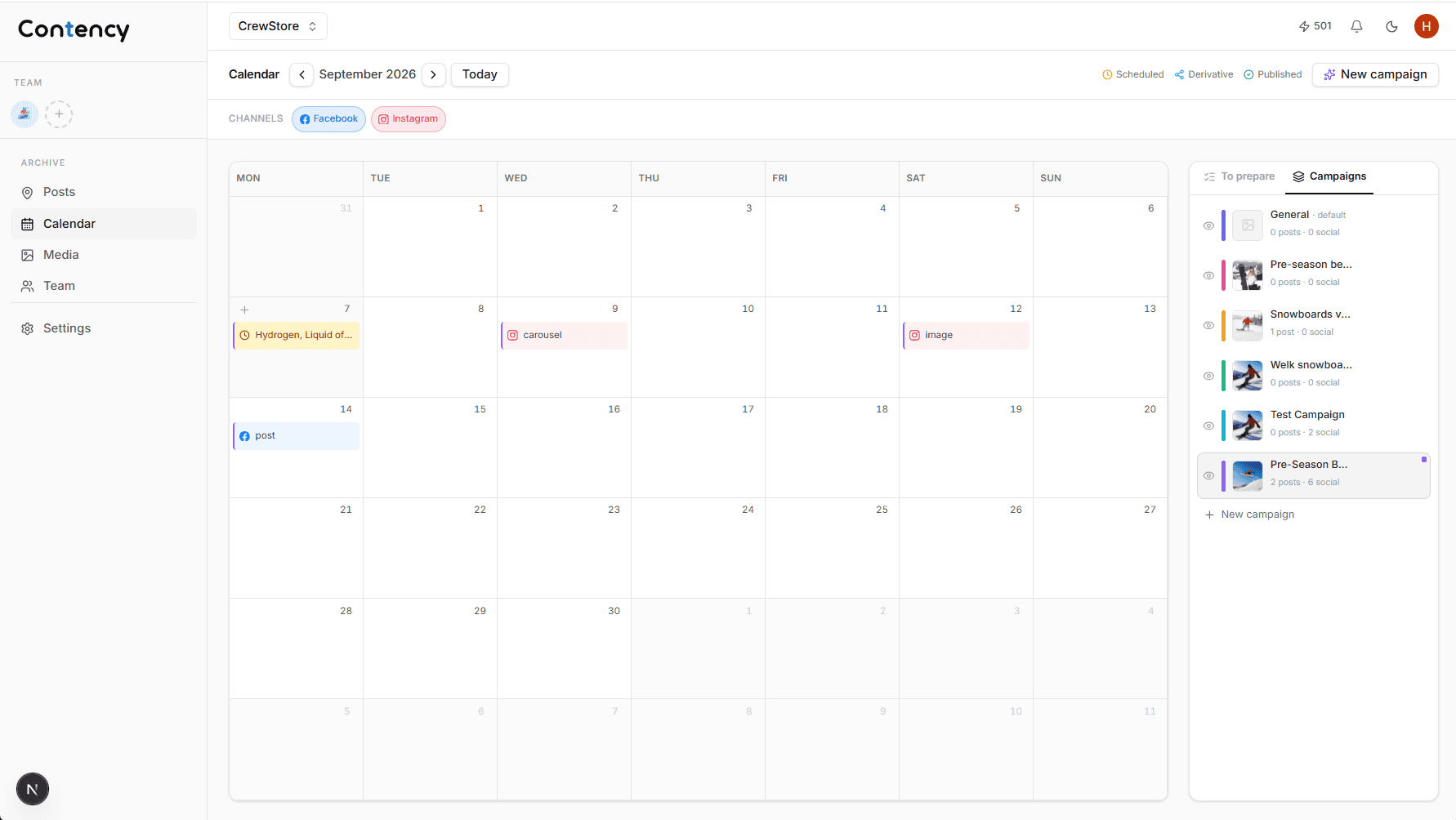
The most logical starting point in Contency is a campaign. You have a goal and you consult with the campaign assistant about what you can do to achieve that goal. Together with the assistant you arrive at a plan that is then scheduled in the content calendar. You then get to work on the individual pieces. You write a blog post and then the platform drafts all the planned derivative posts — in the right format, at the right date and time, ready for the channels you've chosen. Of course, everything includes the necessary approval steps so that you as a user never lose control.
For writing in Contency you work with a team of AI writers. Each writer has their own specialism. Each new post therefore starts with an interview. Just like in the real world, where a journalist asks you all sorts of questions when a good piece needs to be written. During that interview you can share all kinds of things. Notes, sources, photos — whatever you have. Because Contency also has full context of your site, your company, and your target audience, the writer knows what it's about. The writer then gets to work and writes a complete blog. Once the draft is ready, a signal is given and you can get to work in the editor.
The editor in Contency is built for the writer, not the administrator. It's not a standard rich text editor as you often see in a CMS. Everything you write lives there, in an environment built for the writer. Where needed, you can use AI to edit texts or to add additional sections. You can also ask the assistant for a full review or fact check.
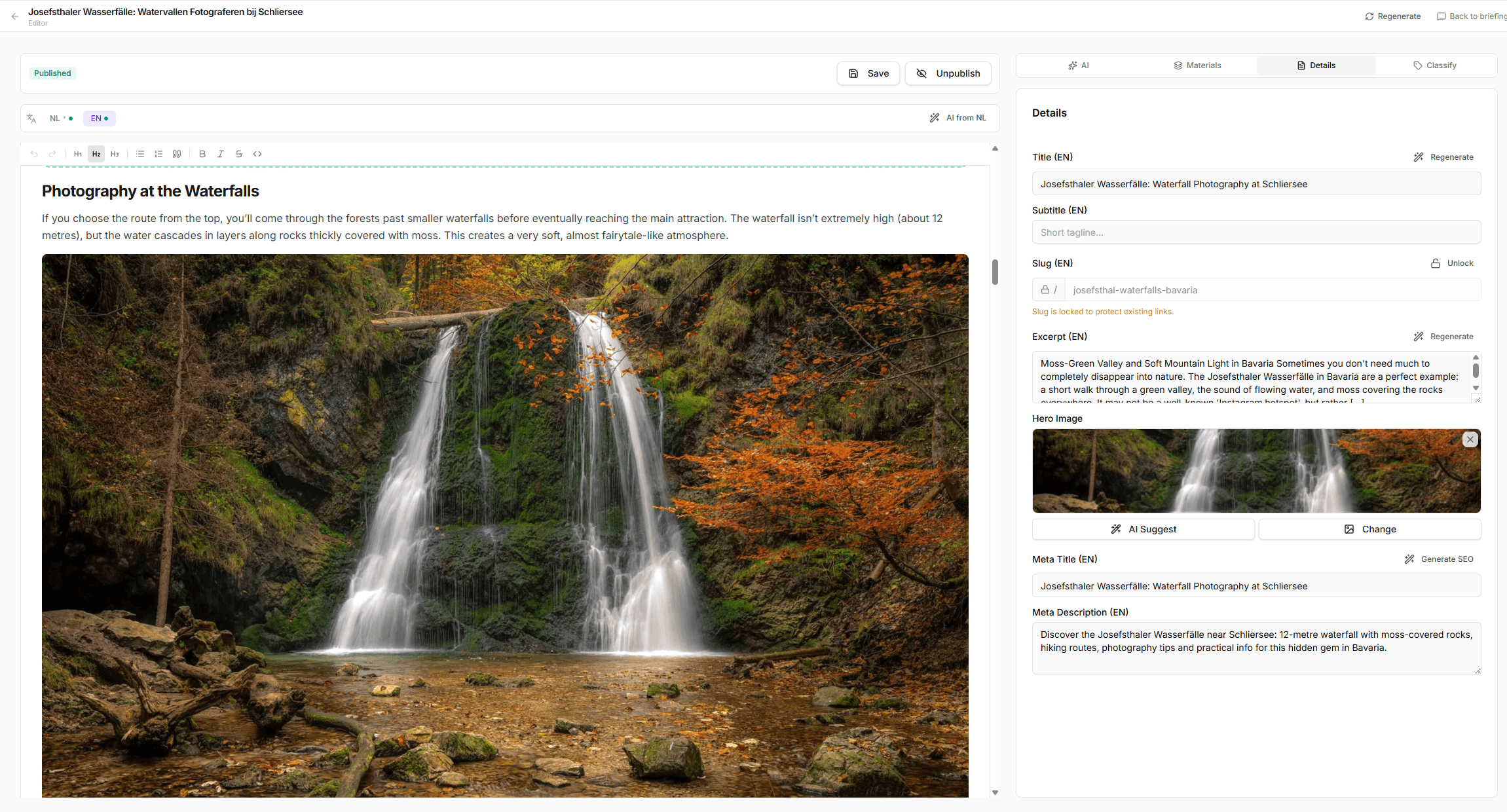
The media library understands what is in an image. If you upload a photo of a market in Valencia, the platform recognises the content — so you can later search for "market" or "Valencia" and find the right image without browsing through a hundred files. That's the difference between an archive and an assistant. Via the AI assistant you can also request a suitable image — it then selects the right medium and applies your brand style.
Once a piece is ready, the content calendar takes over. The campaign assistant prepares the social variants and presents them one by one for approval — so you get to see each piece once more before it goes out. The calendar overview lets you see at a glance what's scheduled and what's missing. Not as an autopilot that publishes for you, but as a structure that helps you stay in control.
Every language version — Dutch, English, or another language — is a fully-fledged piece, not a translation treated as an afterthought. The language switch is at field level in the editor, visible and deliberate. Both versions deserve the same attention — that's a design choice, not a technical detail.
One good piece, in the right places
Contency is built on the conviction that volume is the result, not the goal. A piece that resonates with someone is worth more than twenty pieces that nobody remembers. The platform's job is to carry that one good piece further — to the channels, to the languages, to the calendar — without sacrificing quality in the process.
If you recognise what I'm describing, then Contency is built for you. Schedule a call now and we'll look together at what Contency is and whether it's right for your business.